

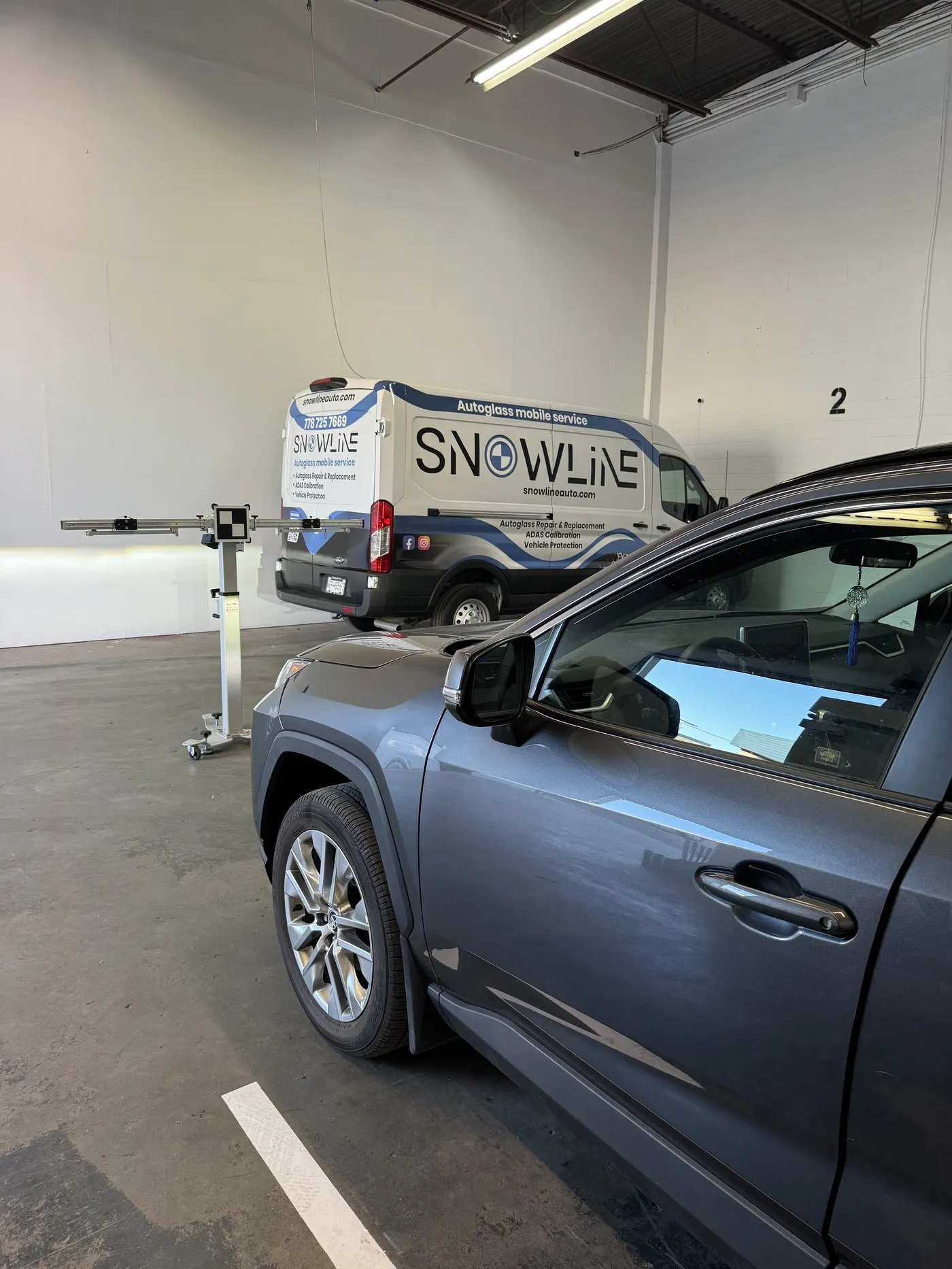

Why calibration became part of every windshield job
Ten years ago, replacing a windshield was straightforward: take out the old glass, put in new glass, let the urethane cure. That’s still the core of the job. But on most vehicles built from roughly 2018 onward, there’s a forward-facing camera mounted to the windshield or the mirror bracket just behind it. That camera powers lane departure warning, lane keep assist, automatic emergency braking, and adaptive cruise control.
When you replace the windshield, that camera’s position shifts. Not by much, but enough to matter. At highway distances, even a fraction of a degree of angular offset translates to significant errors in where the system thinks lane markings and vehicles are. Recalibrating that camera isn’t optional. It’s a required part of the job, and it’s part of every windshield replacement we do here.
How calibration actually works
There are two types of ADAS calibration, and your vehicle may require one or both.
Static calibration is done with your vehicle parked. We position precision calibration targets at manufacturer-specified distances and angles in front of the vehicle, connect a diagnostic tool, and run the calibration procedure. The process takes 45–60 minutes for most vehicles. Controlled lighting and a level floor aren’t incidental requirements; they’re what makes the calibration accurate. We do this in our shop bay by default, where conditions are consistent. For mobile appointments, we can perform calibration on-site if the location provides a covered space, even overhead lighting, and a level surface — a garage typically qualifies, an open parking lot typically does not.
Dynamic calibration is done on the road. A technician drives the vehicle on a specific route, at a specific speed, for a set distance while the system uses road markings and environmental reference points to self-calibrate. Some manufacturers specify dynamic only, some static only, and some require both in sequence. We follow whichever procedure your manufacturer specifies, confirmed before the work starts.
After calibration we provide a printed calibration report showing the procedure performed, the results, and the date. Keep it with your service records.
One appointment, not two
Calibration is included in every windshield replacement appointment at Snowline. We don’t finish the install, hand you your keys, and tell you to book a separate calibration visit somewhere else. The sequence is: install the glass, cure the urethane, calibrate the camera, verify results, hand you the printed report. Total time for a windshield replacement plus calibration is typically 90–120 minutes from when you drop your vehicle.
This matters more than it might seem. Vehicles have been driven (sometimes for weeks) with a freshly replaced windshield and no calibration. The driver assumed the shop had handled it, or didn’t know it was needed, or was told a separate appointment was required and never got around to it. Those safety systems were running on bad data the whole time. We handle calibration on the same day, in the same shop, so that doesn’t happen.
ICBC coverage and out-of-pocket costs
When your windshield replacement is covered by ICBC Comprehensive, calibration is included in the same claim. ICBC recognises calibration as a required part of the replacement process for ADAS-equipped vehicles. We handle all of the billing: there’s no separate authorisation, no second claim, and no surprise charges after the fact.
If you’re paying out of pocket for your windshield, calibration is quoted as part of the total before you commit to the work. We’ll give you a specific quote for your year, make, and model before we order the glass.
Which systems we calibrate
We’ve calibrated Honda Sensing, Toyota Safety Sense, Subaru EyeSight, Ford Co-Pilot360, Hyundai SmartSense, Kia Drive Wise, Mazda i-Activsense, Nissan ProPILOT Assist, and others across a wide range of model years. If you’re unsure whether your vehicle’s system is something we’ve worked with before, ask when you call. We’ll tell you honestly if we haven’t seen your specific configuration and whether we’d refer you elsewhere for that particular job.